A Nigerian Therapist's Discovery: Why Men Can't Stop — Even When They Desperately Want To
After working with over 300 clients, I found something most self-help guides get completely wrong. This is what I discovered — and what finally worked.

He Had Tried Everything. Nothing Worked.
His name is not Emmanuel.
(His name has been changed for confidentiality purposes. He has given permission for his story to be shared.)
But I am going to call him Emmanuel here, because his story deserves to be told.
Emmanuel was 35 years old when he first sat down in my therapy room. He was well-dressed. Articulate. The kind of man who carries himself with a certain composure — the kind other people look at and assume has everything together.
He did not have everything together.
He had been carrying the same secret for more than fifteen years.
It had started when he was a teenager — the way these things often do. Quietly. Privately. At first, it felt harmless. Just something young men did. Nobody talked about it. Nobody would ever know.
But fifteen years is a long time. And what started as a small, private habit had grown into something he no longer felt in control of. Something that pulled at him on idle evenings. Something that followed him through stressful workdays and restless nights.
Something he had tried, over and over again, to stop.
Before Emmanuel came to see me, he had not been passive about this. He had fought. Hard. For years.
He had tried willpower. The kind where you make a firm decision, hold your fists tight, and tell yourself: not today. That lasted three or four days. Then something would happen — a frustrating meeting, a lonely evening, a phone call that went the wrong way — and he would be back where he started.
He had tried website blockers. Downloaded them, set the passwords, felt hopeful for about a week. Then he found himself uninstalling them at 11 pm. His own hands. Undoing his own protection.
He had tried exercise. Running in the mornings. It lifted his mood. It did not stop the urges.
He had deleted apps and reinstalled them the same week. He had made vows during morning devotion and broken them by afternoon. He had prayed about it. Fasted about it. Repented, promised, and started over so many times he had lost count.
And every single time he fell back, the shame compounded.
"Every time I fail," he told me, "I feel worse than before. It's not just that I failed. It's that I failed again. On top of all the times I've already failed."
He had come to me for one specific reason. He had recently met a woman he wanted to marry. And for the first time in fifteen years, he was scared of what he might be bringing into that marriage.
"I don't want to stand at that altar dragging this behind me," he said. "I want to be free first."
The Sentence That Changed Everything I Thought I Knew
I want to tell you about something Emmanuel said in our third session.
We had been mapping out his patterns. Not just when the behaviour happened, but what was happening around it — emotionally, practically, situationally. Where was he? What had just occurred? How was he feeling before the urge appeared?
A picture was starting to form. But it was something he said almost in passing that stopped me completely.
He said it casually. Like it was just an observation.
But I sat with that sentence for a long time after he left.
And that is when the breakthrough came.
Emmanuel wasn't addicted to the behaviour itself.
He was trapped in what I now call the Comfort Loop™ — a hidden cycle that causes the brain to seek immediate relief whenever stress, loneliness, boredom, or emotional discomfort appear.
The behaviour wasn't the problem. It was the brain's solution to a problem it didn't know how else to solve.
And everything he had tried — the willpower, the blockers, the vows, the prayers — had been aimed at the behaviour. Not at the Loop producing it.
That is why none of it worked. Not because he was weak. Because he was solving the wrong problem.
The habit is not the problem. The habit is what happens because of the problem. Until you address the hidden loop driving it, the behaviour will keep returning — no matter how determined you are.
The Comfort Loop™ — The Hidden Reason You Can't Stop
Here is what most people — and most self-help guides — never tell you.
The brain is not trying to sabotage you. It is trying to protect you.
Over years — sometimes over decades — it has learned that a specific behaviour provides fast, reliable relief from emotional discomfort. Stress. Boredom. Loneliness. Anxiety. The restlessness of an idle evening. The weight of a thought you don't know how to carry.
The brain recorded that relief. Every time the behaviour worked, the pathway got a little stronger. A little faster. A little harder to override.
This is the Comfort Loop™. And once it is established, willpower alone cannot break it — because the Loop does not operate at the level of conscious choice. By the time you are aware of the urge, the brain's relief-seeking mechanism is already in motion.
That single reframe changes everything about how this problem must be approached.
It means that blocking access to the behaviour does not break the Loop — the brain will simply find another exit. It means that making promises does not break the Loop — the conscious mind cannot override what the brain has learned to do automatically. It means that exercise and accountability and cold showers do not break the Loop — they manage discomfort temporarily, and the Loop is still there when the management stops.
The only thing that breaks the Comfort Loop™ is a structured process that works at the level where the Loop was formed.
That process exists. Emmanuel went through it. And I have documented every step of it in the guide.
But I am not going to lay out the full framework here.
Not because I am withholding it to make a sale. Because the way the framework works — the sequence, the specific techniques, the order in which each part must be applied — matters. Reading a summary of it is not the same as working through it deliberately. And I would rather you have the real thing.
Why Everything You've Tried Has Not Worked
I want to be direct about this, because I think you deserve a straight answer after years of trying.
Willpower fails because it depletes. The moments the urge is strongest — late at night, after a hard day, when you are tired and emotionally drained — are the exact moments when willpower is lowest. It can delay the behaviour. It cannot remove the need the behaviour is meeting.
Website blockers and deleted apps fail because they target the exit, not the force pushing you toward it. The brain will find another route. You have probably discovered this yourself — your own hands, undoing your own protection.
Exercise, accountability, cold showers — these work while you are doing them. The Comfort Loop™ waits. It is still there on the day you are too tired to run, too overwhelmed to call someone, too worn down to hold the line.
Promises and vows fail because they engage the conscious mind. The Comfort Loop™ operates below that level. By the time the urge feels overwhelming, the rational part of your brain has already been bypassed.
This is not a character flaw. This is how the brain works when a comfort pathway has been reinforced over years.
Every approach that targets the behaviour — rather than the Loop producing it — will eventually fail. Not sometimes. Every time. The brain will always find a way to meet its own comfort needs. Until you address the Loop itself, you are fighting the symptom while the cause continues untouched.
What Happened When We Addressed the Right Thing
Once I understood what was actually happening, I stopped trying to help Emmanuel fight the habit.
We began dismantling the Comfort Loop™ using a structured therapeutic framework.
I am not going to describe every step of that framework here — the guide does that properly. But I will tell you what the work looked like from the outside, so you understand what kind of process this is.
We started by identifying the specific emotional states that were activating his Loop. Not a general sense that he was "stressed" — but the precise texture of the feelings that preceded the urge. Named. Mapped. Made visible, instead of leaving them in the dark where they had always operated.
Then we worked on what happens in the gap between the discomfort and the behaviour. That gap — which feels like no time at all when you are inside it — is where the entire framework operates. There are specific techniques for working inside that gap. Emmanuel learned them. And they changed what was possible.
We addressed what fifteen years of shame had done to his sense of self. Because the shame was not just a consequence of the habit. It had become its own trigger. Every fall produced more discomfort, which fed the Loop, which produced another fall. Dismantling that layer was as important as anything else.
There were other elements — the environmental work, the identity framework, the relapse protocol. The guide covers all of it, in the sequence that matters.
What I can tell you is this: once we began working at the level of the Loop rather than the behaviour, everything changed.
The results were not overnight. Real change rarely is.
But they were steady. And they were real.
| Timeframe | What Changed |
|---|---|
| After 4 Weeks | Frequency reduced from 3–4 times daily to approximately once a day. Urges became noticeably less intense. Emmanuel reported feeling "less like I'm being controlled." |
| After 3 Months | Could go entire days without acting on any urge. The Loop was weakening. He described a growing sense of self-trust he had not felt in years. |
| After 6 Months | Multiple days in a row without acting on urges. Several days with little or no urge at all. Confidence meaningfully restored. Faith re-engaged. Participated in online church services for the first time in years. |
But the change I want to tell you most about was not the habit itself.
It was Emmanuel.
The man who came to me in our first session — guarded, ashamed, quietly hopeless — was not the man I was speaking with six months later. He stood differently. He spoke differently. He had started re-engaging with his church, rebuilding friendships he had let drift, and showing up to his relationship with the woman he loved without the weight of a fifteen-year secret bearing down on him.
"I feel like I can look people in the eye again," he told me. "I don't feel like I'm hiding something anymore. I feel like myself."
That is what this work is actually about. Not just stopping a behaviour. Returning to yourself.
Why I Decided to Share This Beyond My Therapy Room
After Emmanuel, I started seeing the same pattern everywhere.
Other clients. Men who contacted me online. Friends of clients who reached out. The same story, over and over: years of struggling, years of failed attempts, years of shame — and no one in their life they felt they could talk to about it.
I realised something uncomfortable.
The framework that helped Emmanuel — the real work of understanding and dismantling the Comfort Loop™ — exists inside therapy rooms. It is expensive. It takes weeks of appointments. It requires a level of access that most men simply do not have.
And the men who need it most are not the ones sitting in private therapy rooms. They are the ones sitting alone in their rooms at night, after another failed attempt, Googling "how to stop" for the hundredth time and finding the same recycled advice that has never worked.
They are young men in Lagos and Abuja, in Accra and Nairobi. Working professionals. Students. Men preparing for marriage. Men already in marriages, carrying this quietly for years. Men who have prayed about it, fasted about it, made covenant promises about it — and who wonder, in their lowest moments, whether something is simply broken inside them.
Nothing is broken inside them. They have simply never been given the right understanding of what they are actually dealing with — or the right tools to address it.
So I built a guide.
Not as a replacement for therapy. But as a practical, honest system that any man can use — privately, at his own pace — to begin understanding and breaking the Comfort Loop™ that has kept him stuck.
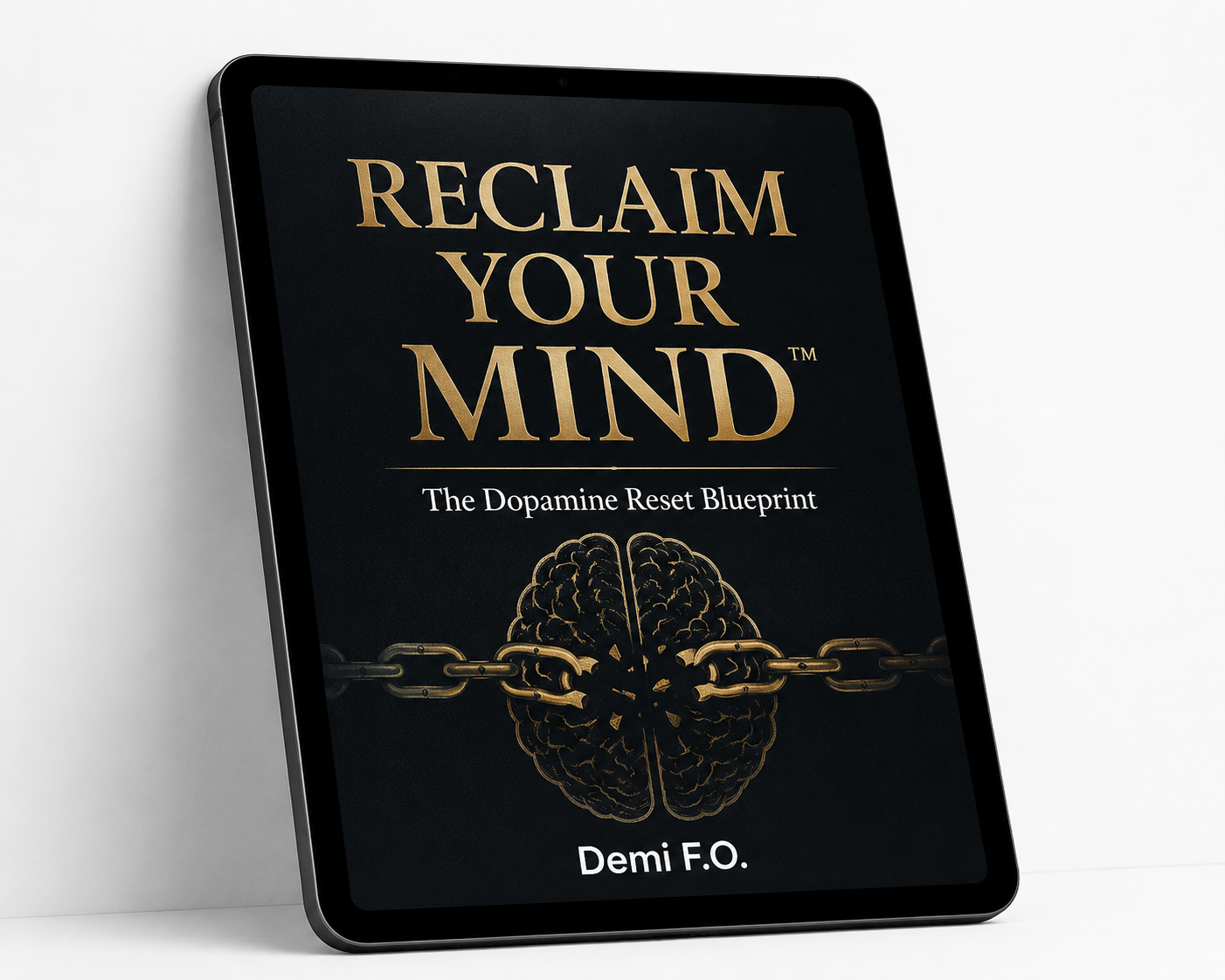
This is not a generic self-help guide. It is the structured therapeutic framework — the same one I used with Emmanuel — documented step by step, so that any man can work through it privately, at his own pace, without needing a therapy room.
It is written for men who have tried everything that targets the behaviour, and who are ready to address what is actually beneath it.
What is inside:
- The complete Comfort Loop™ framework — the full explanation of how your brain formed this pattern, and the structured process for dismantling it at the root
- The trigger mapping method — a specific, guided process for identifying the precise emotional states that activate your Loop. Most men find things here they have never seen before.
- The gap technique — the tool that works inside the critical window between discomfort and behaviour. This is where the real work happens. The guide explains it fully.
- The new comfort pathway protocol — how to give your brain something it can genuinely reach for instead, built in a way that actually competes with what the Loop has been providing
- The shame-to-identity shift — a structured process for addressing what years of shame have done to your self-image. Because shame is not just a consequence of the Loop. For most men, it has become part of it.
- Environmental architecture — practical, private changes to your daily structure that reduce high-risk states before they become high-risk moments
- The relapse protocol — what to do, think, and feel after a slip, so that one difficult day does not erase weeks of genuine progress
- The faith re-integration framework — for men whose spiritual life has drifted during this season, a structured path back without self-condemnation
Instant PDF download · Private and discreet · One-time payment
If you are one of the first 50 men to order today, you will also receive four additional guides — completely free — designed to support every stage of the journey.

A structured, day-by-day challenge designed to help you reclaim your relationship with your devices and your attention — one day at a time. The first thirty days after breaking a loop are the most critical. This challenge is built specifically for that window. It gives you something to move toward, not just something to move away from. Each day has a clear focus, a simple action, and a short reflection. Nothing overwhelming. Just momentum — consistent, building, real.

Shame does something specific to the way you see yourself. Over years — sometimes over decades — it quietly erodes the foundation of your self-image. You begin to carry a version of yourself you would never show to anyone. This workbook is a guided, private process for dismantling that version and rebuilding something truer. It is written exercises only. No apps, no accounts, no exposure. You complete it privately, at your own pace, in any order that feels right. Many men who go through this tell me it is the part of the work they wish they had started sooner.

One of the most underestimated tools in any behaviour change process is simply being able to see your own progress clearly. This private tracking system lets you record your triggers, observe your patterns, and measure genuine improvement over time — without judgment, without performance, just honest data. When the days feel hard, having a clear record of how far you have already come is often the most powerful thing available. Seeing your own trajectory, in your own words, is something no motivational quote can replace.

There will be moments — specific, identifiable moments — when the Comfort Loop™ is pulling hardest. Late at night. After a difficult conversation. In the middle of a long, empty afternoon. These are the moments the Loop was built for. This guide is a short, sharp tool you reach for in exactly those moments. Not a motivational speech. Not a reminder to exercise. Practical, brain-based techniques for the critical 3–7 minutes when the urge is at its most intense — drawn directly from the same framework inside the main guide. Many men say this is the one they keep closest.
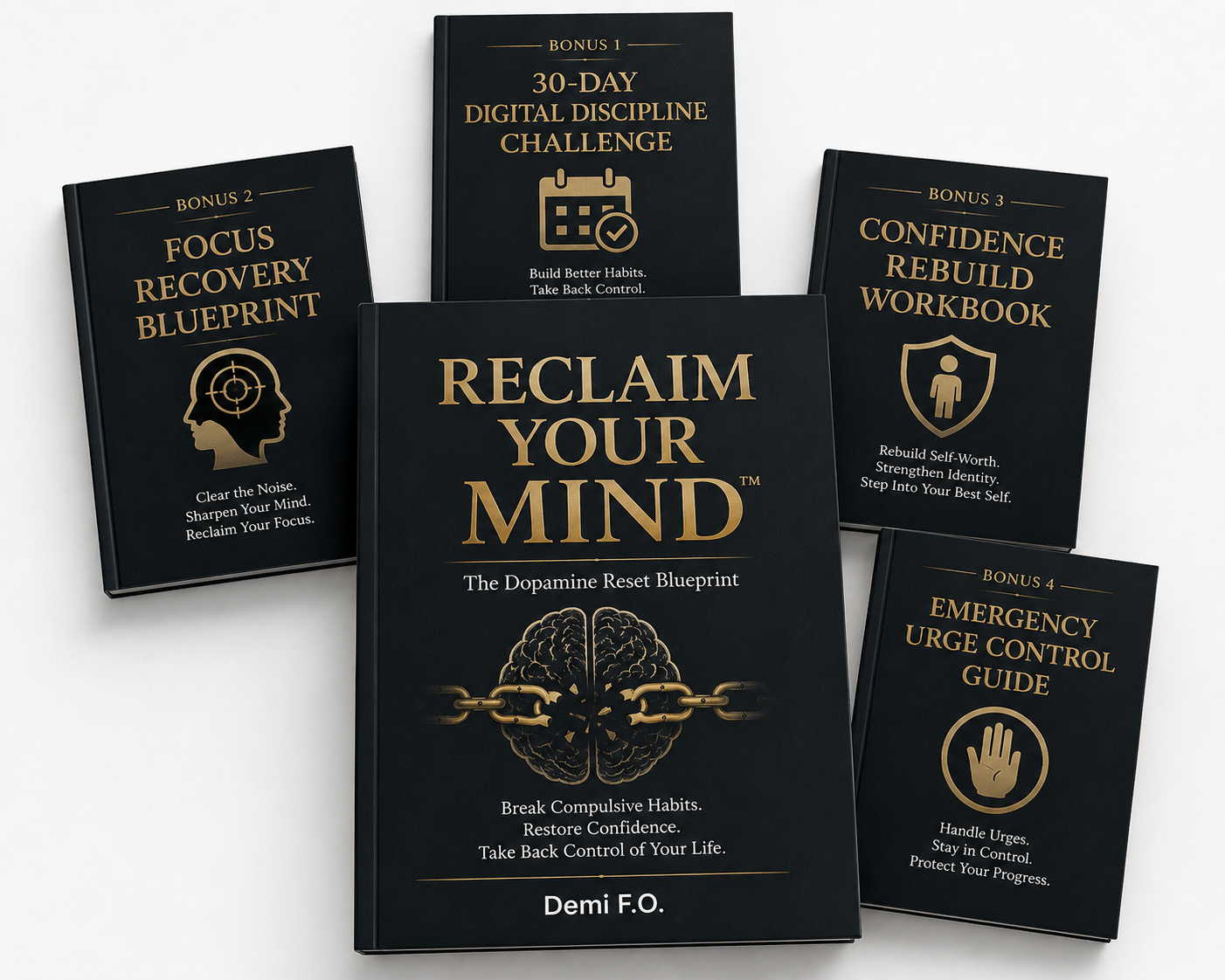
- ✓ RECLAIM YOUR MIND™ — The Dopamine Reset Blueprint (Main Guide) ₦25,000
- ✓ Bonus #1: 30-Day Digital Discipline Challenge ₦10,000
- ✓ Bonus #2: Confidence Rebuild Workbook ₦5,000
- ✓ Bonus #3: Daily Habit Tracker System ₦3,000
- ✓ Bonus #4: Emergency Urge Control Guide ₦5,000
Available for the first 50 men · One-time payment · Instant PDF download
Available for the first 50 men who order at this price
Private. Discreet. Delivered directly to your inbox. No physical package. No name on any label.
What Men Are Saying
These are real messages I have received from men who have used this guide. Names and some details have been changed to protect privacy, but the experiences are genuine.
Before You Click Away
I know what some of you are thinking.
I've spent money on things like this before. It didn't work.
That is fair. The reason those things didn't work is not that you lack discipline. It is that they were addressing the wrong problem. This guide addresses what those things missed.
It's just ₦7,500. If it were really that effective, it would cost more.
I priced this deliberately. The framework inside this guide is what I use with private clients who pay significantly more per session. I priced this low because I want it to reach the men who need it — not just the men who can afford expensive therapy.
I'll deal with it later.
Emmanuel said something to me in one of our last sessions that I want to leave with you.
He said: "I wasted fifteen years telling myself I would deal with it later. Those fifteen years happened. They are gone. I don't want to waste another fifteen telling myself the same thing."
He was talking about a habit. But he was also talking about himself. About the man he could have been sooner. About the relationships he could have entered more freely. About the years spent carrying something he didn't have to carry.
If you keep doing exactly what you are doing now — for one more year, five more years, ten more years — what will that cost you? Not in naira. In your relationships. Your confidence. Your faith. Your sense of yourself. What is that worth addressing today?
₦7,500 is less than most men spend on data in a week.
The cost of not addressing this is harder to calculate.
For the first 50 men · ₦7,500 one-time · Instant private download
Frequently Asked Questions
I've tried so many things before. Why would this be any different?
Because every approach you've tried before was targeting the behaviour. Blocking it. Suppressing it. Replacing it with something else. None of those approaches asked the most important question: why does the brain keep producing this behaviour?
This guide is built around the answer to that question. The Comfort Loop™ framework addresses the underlying function the behaviour is serving — the emotional discomfort it has been reliably solving. Until that is addressed, the behaviour will always come back. When it is addressed, the Loop loses its grip. That is the difference.
Is this going to work immediately? How long does it take?
I will not tell you this is a quick fix. Emmanuel's meaningful progress unfolded over four weeks to six months — and that is what real, lasting change looks like. The guide is a process, not a switch.
What most men notice early is not a complete disappearance of urges, but a shift in their relationship with those urges. They feel less controlled. Less ashamed. More able to observe what is happening inside themselves. That shift tends to happen within the first week or two of genuinely engaging with the material. The deeper changes follow from there.
Is this a religious or faith-based programme?
No. This is a psychotherapy-based framework grounded in how the brain actually works. It does not require any particular religious belief to be effective.
That said, many men who go through this process — including Emmanuel — find that their spiritual life is naturally restored or deepened as the shame lifts and confidence returns. There is a specific section in the guide for men whose faith has been affected, which provides a framework for re-engaging with that dimension without shame or self-condemnation.
Will anyone know I bought this?
No. This is a fully private, digital transaction. The guide is delivered as a PDF directly to your email. There is no physical package, no name on a label, no notification to anyone. It is between you and your inbox.
You can read it on your phone, tablet, or computer — at any time, in any place, at your own pace.
I'm not in Nigeria. Can I still access this?
Yes. The guide is available across Nigeria, Ghana, Kenya, Uganda, South Africa, Zimbabwe, and anywhere else in the world. It is a digital product — if you are reading this, you can access it. The framework is not country-specific; the Comfort Loop™ works the same way in any man's brain, wherever he is.
What if I'm already in a relationship or married? Is this still relevant?
Especially relevant. The Comfort Loop™ does not disappear when you enter a relationship. In many cases, the shame and secrecy involved actively damage connection and intimacy with a partner — often without the partner knowing why. Several of the men whose stories are shared in this post were in relationships or marriages when they began this work. The results they described — feeling present, being truly there with their partner, rebuilding trust with themselves — are directly connected to what the guide addresses.
What if I slip up while using the guide?
The guide includes a specific relapse recovery protocol for exactly this reason. A slip is not a failure. It is information. The protocol walks you through how to respond to a slip in a way that keeps your progress intact rather than allowing a single difficult day to become a week-long spiral. Many men have said this section alone was worth the entire price of the guide.
The goal is not perfection. The goal is a consistently improving trajectory. Those are very different things.
Is this a substitute for therapy?
No. If you have the access and the resources to work with a qualified therapist, I would always encourage that. What this guide provides is structured access to a framework that most men — due to cost, availability, or the very shame that makes seeking help difficult — would never otherwise encounter. It is a starting point, a practical tool, and for many men, a meaningful step toward freedom that they can take privately and on their own terms.
One Last Thing
If you have read this far, something in this article connected with you.
Maybe it was Emmanuel's story — the specific texture of it, the details that sounded familiar. Maybe it was the Comfort Loop™ explanation, and the quiet recognition that you have known this pattern from the inside for years. Maybe it was something smaller — a sentence, a phrase, a moment of feeling understood in a way you haven't felt before.
Whatever it was, I want to say something to you directly.
The fact that you are still trying — after all this time, after all the failed attempts, after all the shame — is not a sign of weakness. It is a sign that somewhere inside you, there is a part that has not given up on the man you know you can be.
That part is right.
That man exists. And the work it takes to get there is not the endless, grinding, willpower-based battle you have been fighting. It is a different kind of work. Quieter. More honest. More sustainable. The kind of work that addresses what is actually happening, rather than fighting a symptom while the cause goes untouched.
Emmanuel is doing well. He got engaged last year.
He stood at that altar in a way he never thought he would.
There are more Emmanuels out there. I know, because I receive messages from them.
I am hoping you will be one of them.
Instant private PDF download · No subscription · No recurring charges
🔒 Private & discreet · ✓ Instant download · 🛡 Therapist-designed
This is not a subscription. You will not be charged again.
"I feel like I can look people in the eye again. I don't feel like I'm hiding something anymore. I feel like myself." — Emmanuel (name changed for confidentiality)
With respect and care,
Demi F.O.
Psychotherapist · M.A. Child & Adolescent Counselling · Specialised in Addiction Counselling
Advertising Disclosure: This article is a paid advertorial for RECLAIM YOUR MIND™, a digital PDF product created by Demi F.O. It is designed to read as editorial content. The author is a real psychotherapist and the client story referenced is based on genuine clinical experience, with the client's name changed and identity protected for confidentiality purposes. Results described are from real users and are representative of their individual experiences. Individual results will vary. This product is not a medical treatment and does not constitute therapy or clinical diagnosis. If you are experiencing significant mental health challenges, please consult a qualified professional in your country.
This article described my situation almost exactly. The part about willpower depleting — I always wondered why I could hold on during the day and then fall apart at night. This explains it. Already downloaded the guide. Thank you.
I've been struggling with this for 12 years. I've prayed about it, done almost everything mentioned here. The Comfort Loop concept is genuinely new to me. It's the first explanation that made me feel like it's not a moral problem — it's a brain problem I can actually work on. Ordering now.
I got it three days ago. I'm only on chapter three but I've already done the trigger mapping. I found five specific emotional states that almost always precede the urge. I've never made that connection. I've been managing symptoms my whole life. Now I understand what's underneath them.
The relapse protocol alone made the ₦7,500 worth it for me. I slipped on day 11. In the past that would have been the end — the shame would have buried me for a week. This time I used the protocol and was back on track by the next morning. That's new. That's completely new.
What hit me hardest was the part about shame becoming its own trigger. I had never thought about that. I've been creating the very emotional discomfort that sends me back to the habit — through the shame of having the habit. It's a closed loop. And now I understand how to open it.
I'm a married man and I was scared to even read this article. I thought it would judge me. It didn't. It explained me. I'm ordering this for myself. Not for my marriage. For myself. Because I've been carrying this long enough.